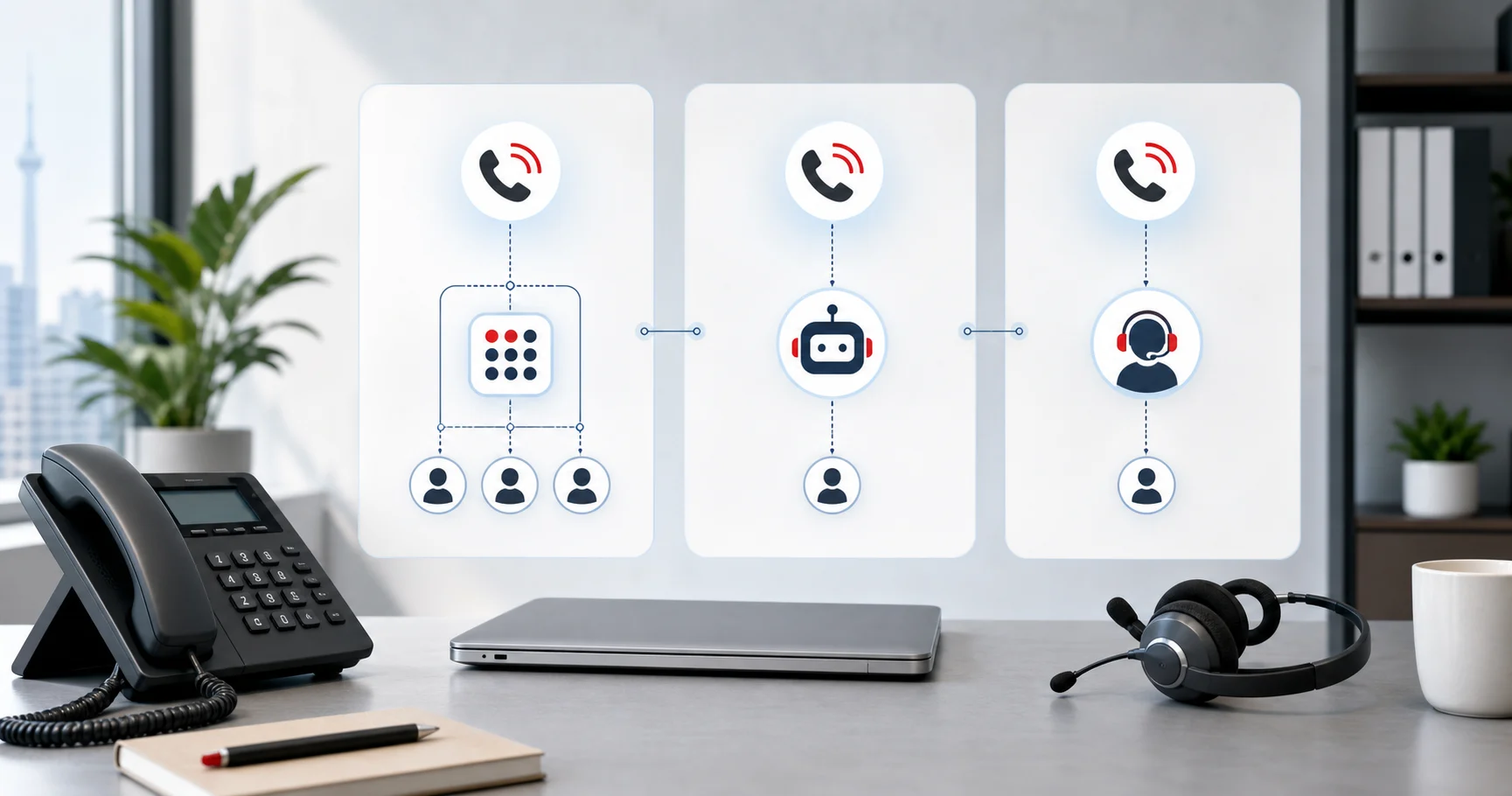
If you have been looking into phone-answering solutions for your business, you have likely encountered both terms: answering service and virtual receptionist. They are often used interchangeably in marketing materials, but they describe meaningfully different things. Understanding the distinction helps you choose the right solution rather than paying for capabilities you do not need, or missing ones you do.
This post defines each option clearly, explains the rise of AI-based virtual receptionists, and gives you a practical framework for deciding which fits your business.
What Is an Answering Service?
A traditional answering service is a call centre, staffed with live agents who answer your business calls on your behalf. The core value proposition is coverage: when you cannot answer the phone, they will.
What a traditional answering service typically does:
- Answers calls in your business’s name
- Takes a message and relays it to you via email, text, or an app
- Forwards calls to your team if specified
- Provides basic information from a script you supply
What it generally does not do:
- Book appointments into your calendar
- Screen callers with customised intake questions
- Answer detailed questions about your services
- Integrate with your CRM, practice management software, or booking system
Pricing model: Most traditional answering services charge per minute of agent time. Rates typically range from $0.75 to $2.00 per minute, plus a monthly base fee. A business receiving 100 calls per month at 3 minutes average call length could easily spend $400 to $600 monthly, not counting overages.
This per-minute model creates a perverse incentive: longer calls cost you more, so agents often keep interactions brief rather than thorough.
What Is a Virtual Receptionist?
Virtual receptionist is a broader term. It covers any service that handles your reception function remotely, without a physical front-desk person in your office.
This includes:
- Human virtual receptionist services: Staffed by trained agents who go beyond message-taking. They handle scheduling, client intake, FAQ responses, and call screening with a higher level of engagement than a basic answering service. Typically more expensive: $250 to $1,500 per month depending on volume and scope.
- AI virtual receptionists: Software-based systems that handle calls automatically using conversational AI. Monthly plans or call pools replace live-agent minute tracking. No agent on the other end. Available 24/7 with no staffing overhead.
The term has evolved. When someone says “virtual receptionist” today, they might mean a person at a remote call centre, or they might mean an AI system. It is worth clarifying which you are evaluating.
What Is an AI Virtual Receptionist?
An AI virtual receptionist is software that answers your business calls, converses naturally with callers, and performs reception tasks without any human agent involved.
Modern AI receptionists can:
- Answer calls 24/7 with no hold times
- Collect caller information and reason for calling
- Answer frequently asked questions using your business’s information
- Book appointments directly into your calendar
- Screen and qualify leads before routing or logging them
- Send call summaries to your team after every interaction
- Transfer calls to the right team member when needed
The pricing model is fundamentally different from traditional services. Dialbox plans use monthly AI-handled call pools instead of public per-minute billing, so buyers can budget around a clear plan and upgrade path rather than live-agent minute overages.
For businesses where call volume fluctuates, this predictability is a significant operational advantage.
To understand how AI changes what was previously only possible with a human-staffed service, see how businesses are replacing voicemail with AI.
Side-by-Side Comparison
| Feature | Traditional Answering Service | Human Virtual Receptionist | AI Virtual Receptionist |
|---|---|---|---|
| Coverage hours | 24/7 | Business hours (extended for premium) | 24/7/365 |
| Pricing model | Per minute + base fee | Monthly retainer | Monthly plan or call pool |
| Typical monthly cost | $300-$800 | $500-$2,000 | $99-$700+ |
| Appointment booking | Rarely | Yes | Yes, with calendar integration |
| Call consistency | Varies by agent | Moderate | Identical every call |
| FAQ answering depth | Basic script only | Moderate | Configurable, detailed |
| CRM/software integration | Rarely | Sometimes | Yes |
| Setup time | Days | 1-2 weeks | Hours to days |
| Simultaneous calls | Limited by staffing | Limited by staffing | Handles simultaneous spikes |
| Call summaries | Email/text relay | Usually yes | Automatic, every call |
Which One Is Right for Your Business?
The honest answer depends on three factors: your call volume, the complexity of what callers need, and your budget.
Consider a traditional answering service if:
- You receive a low and predictable volume of calls (fewer than 50 per month)
- Your callers primarily need to leave messages or be transferred
- You do not need appointment booking or intake screening
- You want a human on the line for every call and can absorb the per-minute cost
Traditional answering services remain a reasonable choice for businesses where calls are infrequent and the primary need is simply coverage. An after-hours overflow solution for a medical practice that handles its own daytime reception is one example.
Consider a human virtual receptionist if:
- Your callers have complex or sensitive needs that benefit from human judgment
- You want more than message-taking but are not ready for AI
- Your call volume is moderate and your budget supports a monthly retainer
- Your industry involves emotional or nuanced conversations where callers value human presence
Human virtual receptionists work well for practices where relationship and empathy matter in the first interaction, and where the volume does not make per-agent costs prohibitive.
Consider an AI virtual receptionist if:
- You want 24/7 coverage without paying overtime or after-hours rates
- Your call volume is high or unpredictable
- You need appointment booking, intake screening, or FAQ answering built into the call flow
- You want consistent, logged, summarised call records automatically
- Your budget favours a predictable monthly plan over variable per-minute billing
AI virtual receptionists have become the default choice for small and medium businesses across professional services, trades, healthcare, and retail. The combination of round-the-clock availability, predictable monthly pricing, and integration with scheduling systems often makes it the most practical option even for businesses that previously assumed they needed a live agent.
A Framework for Deciding
Answer these four questions honestly:
1. When do most of your calls come in? If the majority of your calls arrive during hours you are already staffed and available, after-hours coverage may be all you need. If calls come in at all hours or you are consistently unavailable during business hours too, 24/7 AI coverage becomes much more valuable.
2. What do callers typically need? If callers primarily need to book an appointment, get basic business information, or speak to the right team member, AI handles this well. If most callers have complex, bespoke situations requiring real-time human judgment, a human-staffed service may serve them better.
3. How much does a missed call cost you? If a missed call means a lost client worth hundreds or thousands of dollars, the calculus shifts strongly toward whatever solution answers every call reliably. A plumber, a lawyer, a physiotherapist, and an accountant all share this problem.
4. What is your monthly budget for call handling? A traditional answering service with moderate volume might cost you $400 to $600 monthly. A human virtual receptionist might cost $800 to $1,500. A well-configured AI virtual receptionist typically costs a fraction of either, with broader capability and no variable billing.
The Terminology Trap
One practical note: when evaluating services, do not assume that marketing language maps to actual capabilities. Many traditional answering services now brand themselves as “virtual receptionists” without offering the appointment booking, intake, or integration features the term implies. Ask specifically:
- Do you integrate with my calendar for real-time booking?
- Can you answer specific questions about my services, not just take a message?
- Is pricing per-minute, usage-based, or a monthly call pool?
- What happens when multiple calls arrive simultaneously?
The answers will clarify quickly whether you are evaluating a message-relay service or a full-featured reception solution.
Frequently Asked Questions
Is an AI virtual receptionist appropriate for healthcare or legal practices?
Yes, with proper configuration. You control the script, the intake questions, and the information the AI can share. AI receptionists are used successfully in medical clinics, law firms, physiotherapy practices, and counselling offices. The AI gathers information and books appointments. It does not provide clinical advice or legal opinions.
Can I use an AI virtual receptionist alongside my existing staff?
Absolutely. Many businesses use AI to handle overflow, after-hours calls, and the first-contact screening process while their in-office team manages complex client interactions and walk-ins. AI and human staff complement each other well.
What happens if a caller asks something the AI does not know?
A well-configured AI receptionist handles this gracefully. It can tell the caller it will have someone follow up, take their contact information, and log the question for your team. You can also set up warm transfers to a team member for calls that go beyond the AI’s configured scope.
Choosing the Right Solution
Answering services, human virtual receptionists, and AI virtual receptionists all solve the same underlying problem: your business needs to answer calls even when you cannot. What separates them is the scope of what they can do, the pricing model, and the hours they cover.
For most growing businesses today, an AI virtual receptionist offers the most practical combination of capability, availability, and cost. It does not require you to monitor per-minute billing, train agents, or worry about after-hours staffing gaps.
If you are ready to see how AI-powered reception works in practice, visit Dialbox to learn more.